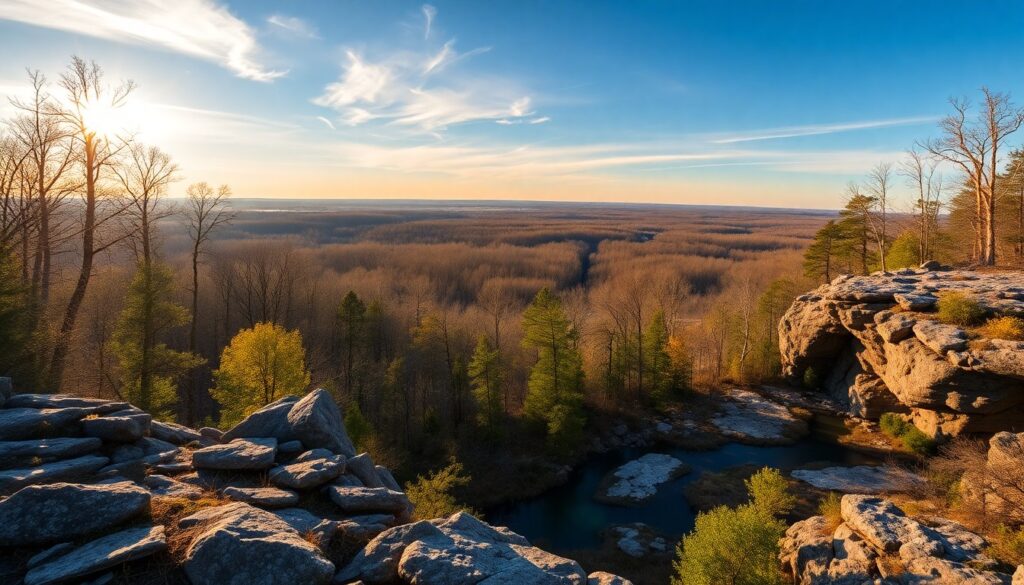
Step onto the sturdy boardwalk and feel the unique spring of the ground beneath, a subtle give that hints at the waterlogged, ancient landscape just beyond the planks. Here, within the heart of Moraine Hills State Park in McHenry, Illinois, lies the extraordinary Moraine Hills Leatherleaf Bog, a rare ecological treasure that transports you to a world shaped by glaciers. The air often carries a cool, earthy scent, tinged with the faint, sweet perfume of bog plants, inviting you to slow down and observe a delicate ecosystem thriving amidst the rolling glacial hills.
Trail Specifications
Trail Name: Leatherleaf Bog Trail
Location: Moraine Hills State Park, McHenry, IL
Distance: 1.5 miles (loop)
Elevation Gain: Minimal (approx. 20-30 feet)
Difficulty: Easy
GPS Coordinates: 42.3488° N, 88.2255° W (Approximate park entrance)
Best Season: Spring, Early Summer, Autumn
Dog-Friendly: Yes, on leash
Route Overview & Natural Highlights
The Leatherleaf Bog Trail offers an immersive journey through a unique landscape, a relic of the last glacial period. This is not your typical woodland hike; much of the trail is comprised of well-maintained boardwalks that float above the saturated, acidic soil of the bog itself, protecting both you and the sensitive plants below. You’ll traverse sections of packed gravel and earthen paths through adjacent woodlands, providing a varied walking experience.
The bog’s ecology is its defining characteristic. Formed in a kettle hole left behind by the retreating Wisconsin Glacier over 10,000 years ago, this acidic environment supports specialized flora. The namesake leatherleaf (Chamaedaphne calyculata) dominates, its leathery leaves and small, bell-like flowers creating dense thickets. Look closely, and you might spot other fascinating bog inhabitants like the insectivorous sundews (Drosera rotundifolia) glistening on the sphagnum moss mat, or the delicate, white-flowered bog rosemary (Andromeda polifolia). Towering above, the unique tamarack (Larix laricina) stands out as Illinois’ only deciduous conifer, its needles turning a brilliant gold in autumn before dropping. Keep an eye out for various waterfowl on the nearby Lake Defiance, a pristine kettle lake, and listen for the calls of warblers and other songbirds that frequent the diverse habitats.
Geologically, the entire Moraine Hills State Park is a living lesson in glacial topography. The gentle rises you encounter are kames and moraines—hills of sand and gravel deposited by the melting glacier. The bog itself is a prime example of a kettle, a depression formed when a large block of ice was buried in sediment and later melted. This ancient history contributes to the distinct character of the landscape, making every step a connection to the immense forces that shaped this part of Illinois.
Turn-by-Turn Trail Breakdown
Trailhead Start: Your adventure begins just a short walk from the main parking area, near the park office. Look for clear signage directing you to the Leatherleaf Bog Trail. The initial segment guides you onto a wide, sturdy boardwalk, immediately immersing you in the bog environment. Interpretive signs along this section provide valuable insights into the unique ecosystem, explaining the formation of the bog and identifying key plant species. Take your time here to absorb the information and prepare for the quiet beauty ahead.
Mid-Trail Features: As you continue, the boardwalk meanders deeper into the heart of the bog. You’ll pass through dense stands of leatherleaf, their waxy leaves creating a verdant canopy. In spring, the air is often filled with the buzz of pollinators visiting the small, urn-shaped flowers. The trail occasionally transitions to packed earth, leading you through areas of mixed woodland that border the bog. Here, you might find oaks, maples, and the distinctive tamaracks. Keep your eyes peeled for wildlife – frogs might dart into the water, turtles could be basking on logs, and various birds are always active, especially around the edges of Lake Defiance, which offers serene views through the trees.
Summit/Destination & Return: The trail forms a loop, gently curving back towards the trailhead. While there isn’t a traditional “summit,” the destination is the profound experience of navigating this rare habitat. As you complete the loop, you gain a broader perspective of the bog’s expanse, often catching glimpses of the surrounding moraines that cradle this ecological gem. The return journey provides an opportunity to revisit sections with fresh eyes, perhaps noticing details you missed on the way in. The trail seamlessly guides you back to the starting point, leaving you with a lasting impression of Illinois’ glacial past and the resilience of its unique flora and fauna.
Seasonal Guide & Best Times
- Spring (April-May): This is a spectacular time to visit. Migratory birds return, and the leatherleaf bursts into bloom with delicate white flowers. The air is crisp, and insect activity is minimal, making for comfortable hiking.
- Summer (June-August): The bog is lush and green, with many plants in full leaf. Keep an eye out for cranberries ripening in late summer. Be prepared for warmer temperatures and higher insect populations; insect repellent is highly recommended.
- Autumn (September-November): A truly magical season. The tamarack trees turn a brilliant golden-yellow before shedding their needles, creating a breathtaking contrast against the greens and browns of the bog. Cooler temperatures and fewer bugs make for excellent hiking conditions.
- Winter (December-March): The bog transforms into a stark, quiet landscape. Snow blankets the leatherleaf, and the skeletal tamaracks stand sentinel. While cold, it offers a unique, serene beauty, especially after a fresh snowfall. Dress warmly and be mindful of icy boardwalks.
Essential Gear & Safety
- Water & Snacks: Even on a short trail, staying hydrated is important.
- Appropriate Footwear: Sturdy walking shoes are sufficient, but waterproof boots can be beneficial, especially after rain or in spring.
- Insect Repellent: Especially during warmer months, mosquitoes and ticks can be present.
- Binoculars & Camera: For birdwatching and capturing the unique bog flora.
- Navigation: While the trail is well-marked, it’s always wise to carry a map or use a reliable hiking app like AllTrails: Leatherleaf Bog Trail on AllTrails.
Getting There & Parking
Moraine Hills State Park is located in McHenry, Illinois, approximately an hour and a half northwest of downtown Chicago. The main entrance is at 1510 South River Road, McHenry, IL 60051. Follow signage within the park to the main parking area near the park office and interpretive center, which serves as the primary access point for the Leatherleaf Bog Trail. There are ample parking spaces available, and as an Illinois State Park, there are no entrance or parking fees. The park is generally open from sunrise to sunset, though specific facility hours may vary. Be aware that the McHenry Dam, a significant landmark on the Fox River, is also nearby, offering additional scenic overlooks and recreational opportunities within the park system.
Curated Literature & Chicago Downtown Calendar
The Architecture of Focus: Deep Work & Modern Mastery
By Founders Library Press
A structured framework for strategic clarity, productivity, and authentic execution.
Upcoming Downtown Happenings
Live acoustic sessions, gallery receptions, literary salons, and independent trade shows across Chicago.